By Synapse Global Institute
Publication
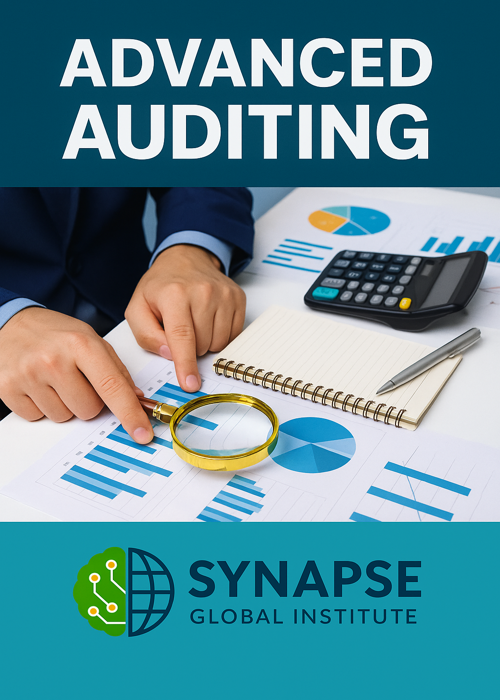
Advanced Auditing
Published
Thu, 05-Jun-2025
Pages
268
M-Pesa PayBill: 400222
Account: 894981#your name or admission number
Example: 894981#SGI001
Co-operative Bank of Kenya
Account name: Synapse Global Institute Limited
Account number: 01101461071001
Bank payment PayBill: 400200
For PayBill 400200, use 01101461071001 as the account number.
Pay the exact amount shown for your selected item. Check the recipient details on your phone before confirming.
Manual confirmation: after payment, contact SGI with your transaction reference, name/admission number and the book or revision-material title. Access is activated after staff verify the payment. This page does not send a PIN prompt or automatically unlock content.
Contact SGI about payment ↗Never share your M-Pesa PIN.
This book, Advanced Auditing, has been developed to provide Certified Public Accountant (CPA) and ACCA students with a thorough understanding of contemporary auditing practices, in alignment with international standards and local Kenyan regulatory frameworks. It is designed to meet the academic and professional requirements of learners preparing for advanced-level audit and assurance examinations, while also equipping practising auditors and financial professionals with a robust reference guide for real-world application.
The text is structured to offer comprehensive coverage of the core and emerging issues in auditing. Key areas include assurance and non-assurance engagements, audit planning and risk assessment, audit evidence, reporting, professional ethics, legal responsibilities, and developments in audit regulation. In addition, the book addresses specialised audit topics such as forensic auditing, sustainability assurance, and public sector auditing—providing both conceptual clarity and practical insight.
The approach adopted is both analytical and illustrative. Real-world case studies from Kenyan and East African contexts are integrated to ground the concepts in local practice. Furthermore, the book adheres to International Standards on Auditing (ISAs), the IESBA Code of Ethics, and local statutes such as the Companies Act, 2015 (Kenya). Where appropriate, the text draws on guidance from regulatory bodies including ICPAK, CMA, and the Financial Reporting Centre.
Every effort has been made to maintain clarity, simplicity, and academic rigour. The chapters are logically sequenced and supported with illustrative examples, engagement letters, sample reports, and exam-oriented discussions that prepare students for professional examinations and workplace competence.
It is my hope that this book will serve not only as a comprehensive academic resource but also as a valuable companion in the auditing profession. I welcome feedback and suggestions for further improvement in future editions.
CPA Ronoh Benson Benhard
Synapse Global Institute
2025